

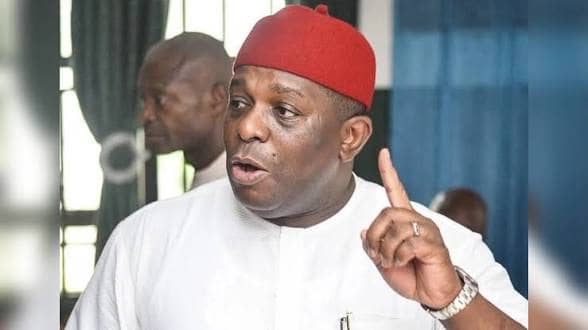
On the twentieth day of May this year, a letter left Umuahia and travelled quietly into the heart of Nigerian politics. It was not loud. It did not shout. It did not carry the usual noise that followed election seasons in Abia State, where drums beat early, posters covered walls before the rains came, and men spoke of power as though it were something a person could hold in his hands and never let go. The letter was dated May 20, 2026, and it was addressed to the National Chairman of the All Progressives Congress through the Abia State Chairman of the party. In it, Sir Mascot Uzor Kalu announced that he had withdrawn his aspiration to contest for the governorship ticket of the party in Abia State. The primary had been fixed for the following day, Thursday, May 21, and he had been one of only three aspirants cleared to stand in it. Yet he stepped aside.
Those who knew him were not entirely surprised that he could do such a thing, though many still struggled to believe it when the news first broke. In a political culture where men clung to ambition until ambition itself broke them, where withdrawal was often read as weakness and where even a lost cause was pursued to the bitter end because pride would not allow a retreat, Mascot Uzor Kalu did something that looked almost old-fashioned. He paused. He consulted. He listened. And then he walked away from the race, not because he had lost faith in himself, but because he had come to believe that some things mattered more than winning.
He had said it plainly in his own words, and the newspapers carried those words the next morning. After wide consultations with family members, friends, and stakeholders, he wrote, he had voluntarily withdrawn his aspiration to contest for the governorship ticket of the All Progressives Congress in Abia State. He admitted that the decision was difficult. He did not pretend otherwise. Any man who had carried a dream for years, who had built a campaign around it, who had travelled from ward to ward and listened to the complaints of market women and the hopes of young men with no work, would have found the decision hard. But he gave two reasons, and both reasons told a story larger than himself.
The first reason was family. His elder brother, Senator Orji Uzor Kalu, had already emerged as the APC senatorial candidate for Abia North for 2027. Mascot argued that his own withdrawal would allow other aspirants the opportunity to contest for the office of governor, and would prevent the appearance that one family sought to hold too much at the same time. The second reason was fairness. After wide and due consultations with stakeholders, he and those around him had concluded that, in the interest of fairness and equity, Abia Central should be allowed to complete its eight years of power rotation, which it had already commenced. It was a principle he had spoken about before, a principle that had long governed the unwritten arrangement of power in Abia, where the governorship moved from zone to zone so that no part of the state felt permanently shut out. He chose to honour that arrangement even when honouring it cost him his own chance.
The reaction came quickly. The Nation reported the withdrawal on May 21, 2026, noting that the letter had been dated the previous day and that the primary was slated for the day after. Leadership described the move as a voluntary withdrawal taken barely twenty-four hours before the primaries, and quoted his statement in full. Premium Times and The Guardian carried the same account, and within hours the story had moved from Umuahia to Abuja and to every political conversation in the South East. The Abia State chapter of the party later confirmed that the withdrawal had not been forced, that it had not come from pressure or persuasion, but had been a personal decision aimed at preserving the party’s zoning arrangement and supporting party unity. The primary went ahead without him, and Eric Opah emerged as the party’s governorship candidate after polling 125,977 votes, defeating Henry Ikoh, who scored 5,905 votes. The contest that had once been a three-man race became a two-man race, and then it was over.
Yet to understand why that letter mattered, one had to go back much further than May 2026, back to a childhood in Aba, back to classrooms in Lagos, back to a young man who left Nigeria for America with little more than hunger and discipline, and back to a return that changed the course of his life. Mascot Uzor Kalu was born in Aba, the commercial heart of Abia, into the family of Johnson Uzor Nsiegbe Kalu and Eunice Kalu. He was the youngest of three brothers who would each make their names in business before politics ever called them. His eldest brother, Orji Uzor Kalu, had begun with almost nothing, with thirty-five dollars borrowed from his mother in the late 1970s, and had built a business empire that carried him into the governorship of Abia State and later into the Senate. His other brother, Nnanna Uzor Kalu, had also built a career in business and public service. Mascot grew up watching that story unfold, watching how enterprise could lift a family and how public office could test it.
After his primary and secondary education in Lagos, he travelled to the United States, where he earned an associate degree in Business Administration from Spartanburg Methodist College and later a bachelor’s degree in Economics and Finance from the University of South Carolina. He did not merely pass through those schools. He worked. He learned the language of money, of markets, of risk, of investment, of the quiet discipline that separated a man who spent from a man who built. He went on to attend professional courses in institutions across the world, and he earned certifications as a Certified Financial Planner and a Life and Health Insurance license. In America, he worked with respected financial institutions, including Vanguard Voyager Services, Vanguard High Network, and Vanguard Participant Services, where his performance earned him awards for excellence, for service, and for merit. Those years taught him something that no campaign rally could teach: that an economy was not an abstraction, that it was made of real people making real decisions about food, about school fees, about rent, about the small capital that could mean the difference between a shop opening and a shop closing.
When he had gained that experience, he built his own enterprise in the United States under the name EUZOR Investment Company, a private conglomerate with interests in food, nightlife, entertainment, properties, logistics, and trading. Red Lion Tavern Restaurants, Zey Motors Company, Zey Trucking, and Charlotte First Properties all operated under that umbrella. In June 2007, the City of Charlotte in North Carolina recognised him as one of the Most Powerful Urban Businessmen of the Year. It was a remarkable honour for a young Nigerian man who had arrived in America without a famous name to protect him, only his work. But even then, his eyes kept returning home.
In 2006, before he formally entered government, he established the Mascot Uzor Kalu Organisation, a non-profit that would go on to empower more than ten thousand youths through scholarships, skills training, and health outreach in Abia. The organisation was born from what he had seen during his travels, from the inequality that followed him even across oceans, from the knowledge that talent was everywhere in Abia but opportunity was not. Long before he ever spoke of running for governor, he was already trying to close that gap, one young person at a time.
In 2007, after much pressure from peers and friends, he returned to Nigeria to serve as Chief of Staff under Governor Theodore Orji. It was a demanding office, one that required a man to manage relationships with civil servants, political office holders, politicians, and ordinary citizens, all while keeping the machinery of government moving. Those who worked with him in those years remembered his calm, his simplicity, his generosity, and his capacity for hard work. He ran the office professionally, he offered unbiased advice, and he helped the governor and the State Executive Council pursue the blueprint of the administration. He resigned in 2010, but the experience left him with an insider’s understanding of how government worked, and how often it failed the very people it was meant to serve.
His political journey after that was not a straight line. He contested the 2023 governorship election under the Action Peoples Party, and though he did not win, he did not challenge the victory of the incumbent, a decision that many observers noted as a sign of his belief that peace mattered more than personal ambition. He later returned to the All Progressives Congress, the party in which his family had long been influential, and in October 2025 he declared his intention to contest the 2027 governorship election under that platform. The declaration was made before party members in Umuahia, and it was carried widely by the press. Vanguard reported that he had formally declared, pledging to build a government that worked for all Abians, especially the underserved at the grassroots level. Punch noted that the 2023 candidate of the Action Peoples Party had now returned to the APC to seek its ticket. Daily Post recorded his promises of financial transparency and of returning the full functioning of Government House to Umuahia, the state capital.
What he said on that day in October 2025 revealed the economist in him, and the man who had spent years watching young people in Abia struggle to find work. He spoke of youth unemployment, which he cited as exceeding sixty-two percent in Abia. It was a staggering figure, and whether it was read as an exact statistical claim or as a cry of alarm, it captured a truth that every family in the state knew. In Aba, young men who had learned a trade could not find customers. In Umuahia, graduates carried certificates that opened no doors. In the rural communities, young women who wanted to farm could not find storage for their harvest, could not find transport to market, could not find capital to grow. Mascot spoke to that pain, not as a slogan, but as a problem he believed could be solved with policy, with discipline, and with honesty.
His economic framework, as reported by Vanguard and as reflected in his public updates on his official Instagram page, rested on several pillars, and each pillar grew out of what he had seen in the markets and streets of Abia. The first was the informal sector, which he described in terms of street capital. He argued that the real economy of Abia did not live in government offices or in the offices of large companies, but in the stalls of traders, in the workshops of artisans, in the small farms that fed families. He proposed targeted support and micro-economic access for small and medium-scale enterprises, for traders, for artisans, and for farmers, so that a woman selling akara could get the small loan she needed, so that a young welder could buy his first machine, so that a farmer could store his yam until the price was fair.
The second pillar was skills and human capital. He believed that vocational training, digital skills, and innovation hubs could move unemployed youths from idleness into productive enterprises. He did not speak of youths as a problem to be managed, but as a resource to be unleashed. He had seen it in his own organisation, where scholarships and skills training had changed lives. He believed that if the state invested in the hands and minds of its young people, those young people would build the economy themselves.
The third pillar was local government autonomy and transparency. He advocated for full financial autonomy for local governments, and for public disclosure of state and local allocations, so that grassroots development would no longer depend on the goodwill of a governor. He promised that allocations due to local governments would not be tampered with, a promise that resonated in communities that had long watched money meant for their roads and clinics disappear into Umuahia. He believed that transparency was not a favour a government did for its people, but a duty, and that a government that hid its books could not be trusted with its people’s future.
The fourth pillar was agricultural value chains. He spoke of post-harvest losses, of the bitter waste that came when farmers harvested and then watched their produce rot because there was no storage, no rural infrastructure, no road to market. He proposed investment in rural storage and infrastructure, so that the labour of a farmer would not be wasted, so that food would reach the table instead of rotting in the field. It was an economist’s answer, but it was also a human answer, born of respect for the men and women who fed the state.
He also criticised what he saw as a lack of transparency and accountability in the state’s administration, pointing to the 2026 budget, which he noted had appropriated more than one trillion naira without adequate consideration for critical sectors affecting women and youths. He decried inflated project costs, citing road construction as a key example. These were not the words of a man who wanted power for its own sake. They were the words of a man who had read budgets, who had built businesses, who knew what a road should cost and what a school should cost, and who believed that Abia deserved better.
His campaign in 2025 and early 2026 was therefore not only about winning an election. It was about changing a conversation. In Umuahia, in Aba, in Ohafia, in the villages where politics often arrived only in the form of posters and promises, he spoke of inclusive and transparent leadership. He spoke of bridging the wide gap between the rich and the poor. He spoke of a government that worked for all Abians. He spoke, again and again, of the youth, not as voters to be used, but as citizens to be served. And when some stakeholders in the APC endorsed another aspirant for the governorship, he condemned the move as an imposition, insisting that the party must allow a free, fair, and transparent process. The party denied any plot to impose a candidate, but the episode showed that Mascot was not a man who would quietly accept what he believed was unfair.
Then came May 2026, and the letter, and the withdrawal. For many politicians, such a moment would have been the end. They would have disappeared, or grown bitter, or begun to plot revenge. Mascot did something different. He continued to promote economic and youth-empowerment initiatives across the state. He continued to speak about the informal sector, about skills, about transparency, about agriculture. He continued to use his official platforms to advocate for the same ideas he had campaigned on. The withdrawal had ended his candidacy, but it had not ended his conviction. If anything, it had clarified it. He had shown that he could walk away from a race and still remain faithful to the reasons he had entered it.
In the months that followed, observers began to speak of him in a different way. He was no longer only a candidate. He had become a symbol of a different kind of politics, a politics in which a man could choose unity over ambition, fairness over advantage, and principle over power, and still keep his dignity. His supporters, who had once hoped to see him in Government House, began to see that his influence did not depend on an office. It depended on his ideas, on his consistency, on his willingness to stay with the people even when there was no election to win.
There is a lesson in that story that goes beyond Abia, beyond the APC, beyond 2027. It is a lesson about what leadership really means. Leadership is not only about holding office. It is about knowing when to step forward and when to step aside. It is about understanding that power rotation is not just a political arrangement, but a promise that every part of a state will have its turn, that no zone will be left behind, that fairness is not a weakness but a strength. It is about understanding that a brother’s success does not have to come at the cost of a family’s honour, and that a party’s unity is worth more than one man’s ambition.
Mascot Uzor Kalu had spent his life preparing for power. He had been prepared by education, by business, by philanthropy, by service as Chief of Staff, by defeat in 2023, by victory in business, by years of listening to young people who had nothing but hope. In the words of one writer who profiled him, he had been meticulously prepared for power. Yet when power came within reach, he chose to set it aside, not because he feared it, but because he respected something larger than it. That choice, more than any campaign speech, defined him.
Today, when his name is mentioned in Abia, it carries a weight that it did not carry before May 20, 2026. It carries the memory of a man who stood at the door of Government House and chose to walk back into the streets, into the markets, into the youth centres, into the conversations about street capital and skills and storage and transparency. It carries the memory of a man who believed that youth unemployment was not a statistic but a wound, and that the informal sector was not a problem but a promise. It carries the memory of a man who understood that a letter, quietly written, could speak louder than a thousand rallies.
History will judge whether his withdrawal helped the APC, whether it helped Abia Central complete its rotation, whether it helped his brother’s senatorial bid, whether it helped the party find unity. Those questions belong to the future. What is already clear is that Mascot Uzor Kalu did not disappear after May 20, 2026. He remained. He continued to advocate. He continued to build. He continued to believe that Abia could be governed with transparency, with fairness, with respect for the small trader and the young graduate and the farmer whose harvest deserved to reach the market. He had walked away from a race, but he had not walked away from his people. And in the long story of Abia politics, that may turn out to be the most important thing he ever did.

